B2B sales has been transformed by the application of many B2C Internet marketing techniques, but there are limits to the Internet where I think B2C can learn something from B2B. For example, with so many cool, self -service real estate websites like Zillow, Trulia, and Redfin available online, why is it that the vast majority of people still prefer to use local real estate brokers to buy and sell their homes? Why not just do it yourself?
Buying a home is complicated. All real estate brokers are required to pass professional certifications, and good real estate brokers spend years honing their craft in the course of many transactions in their local markets. The Internet can serve up all the information you want, but it won’t make you an expert. Plus, buying a home is an emotional roller coaster ride. For the first time home buyer, it can be downright scary. You can get all the disclosures, appraisals, comps and inspections you desire online, but the Internet will not hold your hand and tell you everything will turn out OK in the end.

This is the third post in a series that discusses the new breed of B2B buyer that has evolved in adaptation to the Internet and explores new rules of engagement that mirror those behaviors to maximize B2B sales and marketing effectiveness. The first two posts in this series explored customer self-service and B2B marketing. In this third and final post we turn our attention to B2B sales.
The Self-Service Limit in B2B Sales
A customer’s desire for sales engagement increases in direct proportion to purchase complexity. Thus, purchase complexity is a key element in identifying the right B2B sales model for your business. Simple purchases can be consummated with 100% customer self service, whereas more complex purchases require greater sales engagement as depicted in the image below adapted from the post Three SaaS Sales Models.

Price and complexity define a strategic spectrum of B2B sales approaches
that gravitate strongly toward three distinct B2B sales models:
self-service, transactional and strategic.
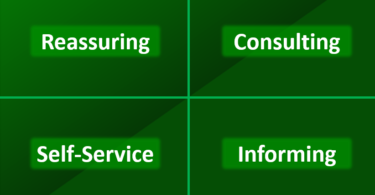
Purchase complexity comes in two flavors: informational and emotional, both of which are clearly present in our earlier home buying example. Informational complexity arises when the buyer requires education to consummate the purchase. Emotional complexity arises when the purchase entails a personal risk to the buyer. When either or both of these purchase barriers becomes high enough, the buyer simply will not make the purchase without the aid of a salesperson. In response, successful B2B sales reps adopt sales behaviors that complement the buyer’s purchase behavior, offering expertise and trust in direct proportion to the respective amounts of uncertainty and fear felt by the buyer.

When a purchase requires extensive knowledge and risk,
the B2B buyer will look to the B2B sales rep to reduce the complexity.
Successful B2B sales reps adopt behaviors that complement the buyer’s behavior,
offering expertise and trust in direct proportion to the uncertainty and fear
arising from the the respective informational and emotional needs of the buyer.
The B2B Sales Arms Race – The New Informed B2B Buyer
The new breed of B2B buyer is online and impatient. When she engages with a B2B sales rep, she’s done her research, but is stuck and doesn’t want to waste the time figuring out how to get unstuck. She doesn’t get something about your website, your product, your pricing or your company, so she sends an email or makes a call to sales. She is well informed, but the purchase complexity has worn out her patience. The worst thing a B2B sales rep can do at this point is wear her patience even thinner.
The new B2B buyer and B2B sales rep are engaged in an information arms race. Read more »